Genuine sustainability in your project
That’s exactly what we work on – every day.
Not because we have to – but because we believe every project counts. And because we are convinced that sustainable construction is not only possible, but essential for a great year 2050.


Sustainable Construction
Genuine sustainability in the construction sector is far more than CO₂ reduction or energy efficiency.

From idea to operation
Sustainability belongs in all project phases
I want to build!
I am building!
I am operating!
We are robustly positioned. We have numerous experts in all areas relevant to construction operations and the construction and real estate industry.






Sustainability needs exchange.
Sustainability at our company
Thinking beyond projects
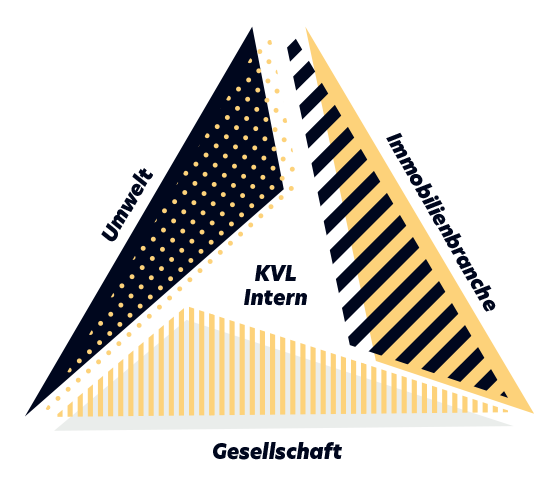
Employees
Social engagement
Environment
Real estate industry
These four areas form the foundation of our understanding of sustainability.
"Sustainable thinking and action worthy of the name aims for longevity and flexibility, rather than high-tech and complexity."
What you want to know about sustainability
How much of Germany’s CO₂ output comes from the construction sector?
What does "sustainable project management" mean at KVL in concrete terms?
What is an ESG Due Diligence and what is it needed for?
Can KVL advise on funding within projects?
Is KVL officially accredited as an energy consultant?
Does KVL offer sustainability training for companies?
Which professional associations is KVL involved in for sustainable construction?
Which publications on sustainable construction has KVL co-written?
What does sustainability mean at KVL beyond individual projects?
Related Literature


Sustainability Through Project Management
Compendium of Sustainable Buildings - Structural Engineering
In the article "Sustainability Through Project Management," the KVL Group presents a comprehensive chapter examining the role of holistic project management in the implementation of sustainable buildings throughout their entire lifecycle. Drawing on practical experience, current regulations, and methodological approaches, the publication demonstrates how ecological, economic, and social goals can be systematically integrated into project preparation, planning, execution, and completion. A particular focus is placed on the early development of project-specific sustainability strategies, bridging competency gaps on the client side, and coordinating interdisciplinary expertise—ranging from LCA/LCC, subsidies, and competitions to integrated planning, lean construction, and circular building approaches.
The chapter was authored by Luana Cortis, Niklas Erdle, and Benjamin Pleuser and combines practical tools with clear recommendations for action. It is part of the "Compendium of Sustainable Buildings – Structural Engineering" (Kompendium Nachhaltige Bauwerke – Hochbauten), a living publication from Springer Verlag being released in stages since 2025, with content developed in close collaboration with the Technical University of Munich. Through this work, our team makes a significant contribution to the advancement of modern, responsible project management for sustainable construction projects.

Legal Handbook for Sustainable Planning, Construction, and Operation
Implementing ESG Requirements
Sustainability and climate protection play a central role in the construction and real estate industry. Whether through national laws, requirements from funding providers such as the KfW, or European taxonomy regulations, the requirements are diverse. However, terms like sustainability or ESG are not always used consistently, and requirements vary—practical implementation in real estate contracts is still in its infancy. In addition to legal challenges, a specific catalog of requirements for real estate has emerged in practice: life cycle assessments, the CRREM pathway, or ESG verifications are still uncharted territory for many legal practitioners.
For the first time, this legal handbook offers a holistic view of all essential legal areas affected by sustainability in the building sector. This standard reference work is not limited to specific phases but is oriented toward the life cycle of the property. From planning and construction to usage, all essential phases and the associated legal issues of sustainability are covered. The legal areas involved include: architectural law, project management law, public building law, energy law, procurement law, private construction law, and tenancy law. Specific aspects of insurance and finance law are also taken into account.
The legal handbook contains numerous practical tips and sample contract clauses.
Luana Cortis from KVL Projektentwicklung Plus has written a chapter for this publication on real estate financing in the context of sustainability aspects and ESG.
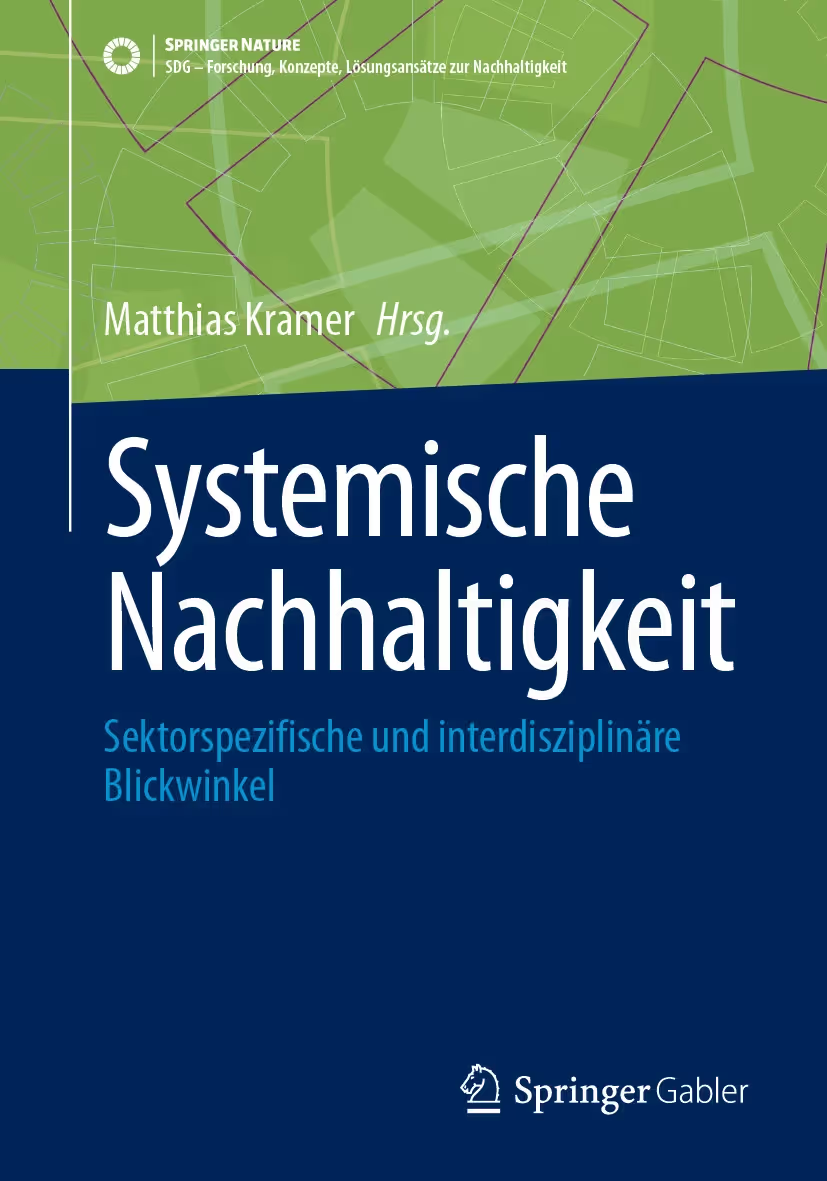
Systemic Sustainability
Sector-specific and interdisciplinary perspectives
Climate change is no longer a distant threat—it is a reality with tangible impacts on our environment, economy, and society. This book examines the complex challenges and potential solutions for a sustainable transformation across key sectors, including construction, transport, agriculture, and consumer behavior. It bridges the gap between scientific perspectives and practical recommendations, demonstrating how to systematically resolve conflicts between climate protection, economic viability, and social development.
In the chapter "Thinking Sustainability in Construction," Benjamin Pleuser and Prof. Dr. Markus G. Viering analyze the role of the building sector in achieving climate goals. With a focus on life cycle assessments, ESG criteria, and circular materials, it becomes clear: sustainable construction is not just an option, but a prerequisite for future-proof architecture and real estate development.
Our CO₂ clock is ticking
And it doesn’t show the time, but what we have left:
And what we need to keep in mind: the construction sector has an enormous lever!
Because it causes around one third of all CO₂ emissions worldwide. In Germany even more: 40% of emissions come directly or indirectly from the construction sector. So: if we want to meet the 1.5°C target, we need to start with construction. And not at some point in the future – but today, here and now.